
| ROYAL NETHERLANDS ARMY BADGES |
| ZNAČKE KRALJEVSKE NIZOZEMSKE VOJSKE |


|
Nakon Drugog svjetskog rata Nizozemska vojska (KoV) se odlučuje za britanske modele borbene i službene uniforme. Istovremeno se donosi i odluka o uvođenju novih oznaka za sve grane i službe. Nove značke za beretke su dizajnirane tako da su na stilizirano W, što je bio inicijal tadašnjeg vladara, Nj. V. Kraljice Wilhelmine, dodavani amblemi službi ili jedinica. Gdje je to god bilo moguće, koristili su redizajnirane oznake iz predratnog vremena. Sve oznake za bertke (sa jednim izuzetkom) su visoke 4,8 cm, a široke 6 cm. Samo su značke Mobilne odbrane (Mobiele Colonnes) bile manjih dimenzija, ali su one korištene na „titovkama“. |
||
|
|
||
|
After the Second World War the Dutch Army decided to take over the British „Battle Dress“ and „Service Dress“. At same time new badges were introduced for various Arm and Service branches. The new badges were institued by Order Nr. 57 of 1947 (Ministerial Order from 9th of November 1946). Beretbadges design were created by placing an emblem on stylized W, initial of the then sovereign, H. M. the Queen Wilhelmina. All the berets therefore have a same dimensions: 4,8 cm high and 6 cm lenght. Only exception was Mobile Defence beret badge, it was smaller, but was used on forage caps. Where was possible, new insignia was derived from pre-war badges, such as the granade for Grenadiers, the crossed guns for the artillery, etc. |
||
| ARMY PAY CORPS ADMINISTRATIVNI KORPUS Militaire Administratie | ||
|
Znak se sastoji od papirusovog cvijeta položenog preko mača koji se nalaze na „standarno“ stiliziranom slovu W. Znak je odobren Uredbom br 57 iz 1947 godine. Podloga je u ljubičasto-crvenoj boji. Papirus je, u starom Egiptu, služio kao materijal za izradu papira, dok mač simbolizira vojne zadatke. Oficiri, pripadnici Administrativnog korpusa sa završenim obrazovanjem za računovođe iznad lijevog prsnog džepa nose značku od sjajnog metala koja prikazuje četverokraku zvijezdu, formiranu sa osam čvorova od papirusovog cvijeta. U sredini značke se nalazi lav iz Nizozemskog grba. |
||
 |
||
|
On stylized W a papyrus flower is laying on a vertical sword hilt uppermost. Badge is approved by Army Order Nr. 57 from 1947. Service colour is pink-red. The flower of the payrus plant supplied the meterial for the preparation of paper in the old Egypt, and sword symbolizes the military task. Officers from Army Pay Corps (Militaire Administratie) haave received education of accountant. These officers wear above the left breast pocket a badge of gilt metal showing a four pointed star, formed by eight knots of the papyrus flower. In the middle of the badge is lion from the Dutch Coat of Arms. |
||
| FIELD ARTILLERY POLJSKA ARTILJERIJA Veldartillerie | ||
|
Poljska artiljerija na znaku ima dvije ukrštene topovske cijevi nad kojima stoji kraljevska kruna. Boje ove grane su crna sa crvenim rubom. Oficiri imaju oznaku sa crnim baršunom i crvenim rubom. Znak je uspostavljen Uredbom br. 57 iz 1947. godine. Od 1945. do 1950. godine postojalo je devet artiljerijskih regimenti, koje su Uredbom od 01. 06. 1950. godine reducirane na tri regimente sa imenima „Prins Frederik“, „Prins Maurits“ i „Van Essen“. 11-ta regimenta nastavlja tradicije Konjičke artiljerije (Korps Rijdende Artillerie). Oni nose stari model kape sa šiltom (forage-cap) na kojoj je žutom svilom izvezen grb od ukrštenih topovskih cijevi nadvišenih kraljevskom krunom. |
||
 |
||
|
Field artillery (Veldartillerie) badge have two crossed gunbarrels surmounted by a Royal Crown. Service colours are black with red piping, for oficers of black velvet. Badge is approved by Army Order Nr. 57 from 1947. Two crossed gunbarrels have been the badge for the Artillery since 1815. From 1945 till 1950 nine field artileire regiments existed. By the Council order of 1st of July 1950 number of regiments was reduced to three, named: „Prins Frederik“, „Prins Maurits“ and „Van Essen“. The 11th Field Artillery Regiment continues the traditions of the former Korps Rijdende Artillerie (Konjička artiljerija). They wear a dark blue forage-cap on wich at the front two crossed gunbarrels and a crown of yellow silk are embroidered. |
||
| ANTI-AIRCRAFT ARTILLERY PROTUAVIONSKA ARTILJERIJA Luchtdoelartillerie | ||
|
Protuavionska artiljerija (Luchtdoelartillerie) na znaku ima dvije ukrštene topovske cijevi nad kojima stoji kraljevska kruna, a sve je položeno na vodoravni propeler. Boje ove grane su crna sa crvenim rubom. Oficiri imaju oznaku sa crnim baršunom i crvenim rubom. Znak je uspostavljen Uredbom br 57 iz 1947. godine. Ukrštene topovske cijevi sa propelerom su u upotrebi od 1922. godine. Od 1945. do 1950. su postojale tri regimente, a od 50-te broj raste na šest: teška PAA: „Rhonen“, „Waalhaven“, „Ypenburg“ i „Hoek van Holland“ te laka PAA „Betuwe“ i „Kornwerderzand“. Teška PAA je zamijenjena protivavionskim raketama. Imena svih šest regimenti su imena gdje su se PAA jedinice suprotsatvaile Njemcima 1940. godine. |
||
 |
||
|
Anti-aircraft artillery (Luchtdoelartillerie) badge have two crossed gunbarrels surmounted by a Royal crown. The intersection of the guns is lying on a horizontal propellor. Service colours are same as field artilleire. Badge is approved by Army Order Nr. 57 from 1947. Two crossed gun barrels with propellor have been the badge of Anti-aircraft artillery from 1922. In 1950 this service expand from three regiments to six. Heavy Anti-aircraft artillery regiments were: „Rhonen“, „Waalhaven“, „Ypenburg“ and „Hoek van Holland“, and light ones were „Betuwe“ and „Kornwerderzand“. Heavy artillery wos abolished when anti-aircraft rockets were introduced. The regimental names recall the places where the former Anti-aircraft artillery fought against Germans in 1940. |
||
| ENGINEERS INŽINJERIJA Genie | ||
|
Šljem borbene inžinjerije (pionira) se koristi za obadvije oznake: beretku i revere. Za revere dolaze u paru i to lijevi i desni znak. Podloga za značku sa beretke je tamno smeđe boje. Znak je odobren Uredbom br. 57 iz 1947. godine. Sličan znak koriste u mnogim vojskama svijeta, pa tako i u Nizozemskoj. Danas ga nose svi inžinjerci, uključujući i pionire (borbena inžinjerija) te pontonirce. Inžinjerija nastavlja tradicije „Regiment Genitroepen“. Na znamenju inžinjerije (colours) stoje natpisi: „Veldotcht 1815“, „Krijgsverrichtigen 1830 en 1831“, „Citadel van Antwerpen 1832“ i „Roterdam 1940“. |
||
|
|
||
|
A sapper's helmet is insignia for beret badge and for collars. Collar badges comes in pair, left aand right. Beret badge background is dark brown. Institued by Army-order Nr. 57 from 1947. In many Armies used the ancient Greek helmet was for a long time bage of the Netherlands engineers (Genie). The badge is nowdays also worn by pioneers and pontoneers. The „Genie“ continues the tradition of the „Regiment Genietroepen“. On the regimental colours are the inscriptions: „Veldotcht 1815“, „Krijgsverrichtigen 1830 en 1831“, „Citadel van Antwerpen 1832“ and „Roterdam 1940“. |
||
| ENGINEERS - PIONEERS INŽINJERIJA - PIONIRI Pionires | ||
|
Na ovom znaku leže ukršteni kramp i lopata preko kojih je položen inžinjerijski šljem. Podloga za znak je bila tamno smeđa – boja inžinjerije kojoj su 1963 i pripojeni. Tada su pripadnici pionirskih inžinjerijskih jedinica zamijenili ovaj znak onim redovne inžinjerije. Tada su i ponotonirske jedinice doživjele istu promjenu. |
||
 |
||
|
A crossed spade and pickaxe hold a sapper's helmet in the badge centre. Service colour was dark brown. Badge was instituted by Army order Nr. 57 from 1947. This insignia was abolished in 1963, and engineers badge was introduced. |
||
| CAVALRY KONJICA | ||
|
Konjička oznaka je napravljena od metala srebrene boje (za razliku od većine ostalih značaka). Na znaku je Sveti Đorđe na konju koji kopljem ubija zmaja. Konjička boja je svjetlo plava, a regimente se razliku po boji rubova. Znak Hussars Van Boreel-a odobren Uredbom br. 57 od 1947. godine ima svjetlo plavu podlogu sa tamno plavim rubom (piping). Husari Princa Alexandera uredbom br. 35 iz 1951 godine uz znak dobijaju svjetlo plavu podlogu sa crvenim rubovima i na kraju, husari Van Sytzama 1952 godine Uredbom br. 59 sa znakom dobijaju podlogu svjetlo plave boje i bijelog ruba. Regimenta Van Boreel nasljeđuje tradicije 2. i 4. husarske regimente te 1. i 2. odreda oklopnih kola. Husari Van Sytzama nastavljaju tradicije 1. husarske regimente. |
||
 |
 |
 |
|
CAP BADGE |
HUSSARS REGIMENT VAN SYTZAMA | INFANTRY REG. VAN HEUTSZ |
| Cavalerie | Regiment Huzaren Van Sytzama | Regiment Huzaren Van Heutsz |
| Konjica | Husarska regimenta "Van Sytzama" | Husarska regimenta "Van Heutsz" |
|
On this badge is Saint George on horsback, killing a dragon with his lance. Badge is madden from silver coloured metal. Colarbadges comes in pairs. Service colour is light blue. For Hussars Van Boreel is light blue with dar blue piping, Hussars of Prins Alexander with ponceaured piping and for the Hussaars Van Sytzama with white piping. Backround colours and badges are institued for Hussars Van Boreel by Army Order Nr. 57 of 1947, for Hussars of Prins Alexander by Army Order Nr. 35 of 1951 and for the Hussaars Van Sytzama by Army Order Nr. 59 of 1952. The Hussars Van Boreel continue traditions of the 2nd and 4th Hussars Regiment and of the 1st and 2nd Armoured cars squadrons. The Hussaars Van Sytzama continue the tradition of 1st Hussars Regiment. |
||
| INFANTRY PJEŠADIJA Infanterie | ||
|
Rimski štit je položen na vertikalno postavljeni mač sa drškom prema gore. Sve leži na traci sa motom: Ne zaustavlja me ništa. Štit simbolizira odbranu, a mač napad. Znak je odobren Uredbom br. 57 iz 1947. godine. Isprva su ga nosili svi pripadnici pješadijskih regimenti, mitraljeskih i minobacačkih bataljona. Danas ga nose samo vojnici pješadinci koji nisu dio neke regimente, zatim pitomci Škole rezervnih oficira pješadije i tehničara specijalista kao i pripadnici Nacionalne rezerve. |
||
 |
|
|
|
A Roman shield is lying on a vertical sword, hilt uppermost and resting on a scroll in which the motto „Nulli cedo“ (I yield for nothing). Badge symbolizes attack (sword) and defence (shield). Service colour is ponceaured. Badge was institued by Army-order Nr. 57 from 1947. Originally badge was worn by all numbered infantry regiments, machine-gun and mortar battalions. At present it is worn only by servicemen who are not incorporated in one of infantry regiments, the students of the Reserve Officers School (School reserve officieren) at Kader Infanterie and the Depot Tehnical Specialists. |
||
| LIMBURG RIFLES LIMBURŠKI STRIJELCI Limburgse Jagers | ||
|
Limburški strijelci (Limburgse Jagers) su laka pješadijska regimenta Kraljevske Nizozemske Kopnene vojske. Ime je dodijeljeno jer su njeni pripadnici uglavnom regrutirani u južnoj pokrajini Limburg. Trenutno su sastavni dio 13. motorizirane brigade. Ova regimenta nastavlja tradicije 2., 6. i 11. pješadijske regimente. Danas se svaka od nizozemskih regimenti sastoji samo od jednog bataljona. Na „regimentalnim bojama“ su ispisani datumi i mjesta vezani uz njihovu povijest: Quatre-Bras 1815, Waterloo 1815, Tiendaagse Veldtocht 1831, tvrđava Antwerpen 1832, Venlo 1940, Roermond 1940, Zutphen 1940, Zapadna i srednja-Java 1946-1949, i Sjeverna Sumatra 1947-1949. |
||
|
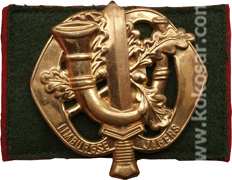
Znak se sastoji od lovačkog roga položenog na mač i oko njih je savijena lisnata hrastova grana. Na dnu osnove značke je ispisano: „Limburgse Jagers“. Boje regimente su zelena na jarko crvenoj podlozi. Oznake za revere dolaze u paru, lijevi i desni. Znak je uveden Uredbom KoV-a br 35 iz 1951. godine. |
||
 |
||
|
Regiment Limburgse Jagers (Limburg Rifles) is a light infantry regiment in the Royal Netherlands Army. It is named for the Dutch province of Limburg, and currently serves in the infantry role as part of 13th Motzorized Brigade.The Regiment continues the traditions of the 2nd, 6th and 11th Infantry Regiment. The personal is mainly recruited in the South-Netherlands province of Limburg. Battle Honours displayed on the regimental colour: Quatre-Bras 1815, Waterloo 1815, Tiendaagse Veldtocht 1831, Citadel van Antwerpen 1832, Venlo 1940, Roermond 1940, Zutphen 1940, West- en Midden-Java 1946-1949, Noord-Sumatra 1947-1949. |
||
|
On the badge we can see a hunting horn on a sward pointing upwards. Trough the horn and sword an oak-branch with leaves is twisted. On the lower edge of the beret badge are words: „Limburgse Jagers“. Service colour is green with crimson. Collar badges comes in pairs, left and right. Badge was approved by Army order Nr. 35 of 1951. |
||
| ROYAL MILITARY SCHOOL KRALJEVSKA VOJNA ŠKOLA Koninklijke Militaire School | ||
|
Na podlozi od stiliziranog W se nalaze dva ukrštena koplja nadvišena kraljevskom krunom. Koplja su zajedno povezana trakom. Boja službe je crvena. Oznaka je uspostavljena Uredbom br. 62033 iz 1962. godine. Kraljevska vojna škola je osnovana 1952. godine u Weertu. To je škola za obuku profesionalnih narednika i do 1962. godine je nosila naziv: Podoficirska škola. Za boravaka u školi pitomci nose boju podloge koja odgovara njihovoj službi, a osoblje škole nosi crvenu podlogu. |
||
 |
||
|
Badge consist of two crossed pikes held together by a ribbon all surmounted by a Royal Crown. Service colour is ponceaured. Badge is approwed by Army order nr. 62033 from 1962. The KMS (Koninklijke Militaire School) was established in Wert in 1952. It is the training school for regulr sergeants and was called Onderofficiers school until 1962. During the pupil's stay at the training school of their Arm of service the colour of the background is the same as for the concerned Arms of Service. |
||
| MEDICAL CORPS SANITETSKI KORPUS Geneeskundige Troepen | ||
|
Eliptični štit položen na standardnu podlogu drži na sebi eskulapov štap ukršten sa mačem. Okruženi su vijencem od lovorovog i hrastovog lišća na vrhu spojeni tekstom „Eripendo Victoriae Prosum“ (spašavajući borce od smrti pobjeđujem). Sve to nadvisuje kraljevska kruna, koja leži na vrhu znaka. Za medicinski korpus je izabrana zelena podloga, za vojnike od čoje, a oficire od baršuna. Znak je odobren uredbom br 35 iz 1951. Ovaj se korpus (regimenta) sastoji od sanitetskih i farmaceutskih jedinica. Obadvije ove grupacije su prije imale svoje vlastite oznake. |
||
 |
 |
 |
| CAP BADGE | COLLAR BADGES | COLLAR BADGES |
| Oznaka za beretke | Oznake za revere | Oznake za revere |
|
On Medical corps badge an eliptical shiel holds aesculapius cossed with sword. This is surrounded by a wreath of laurels and oakleaves, surmounted by a Royal crown, which is lying on the badge's. On the uppergrade stands the motto „Eripendo Victoriae Prosum“ (by snatching the combatants from death, I contribute to victory). Backround is green, for officers velvet. Instituted by Army order Nr. 35 of 1951. The Regiment is composed of the Regiment „Geneeskundige Troepen“ and the „Tandheelkundige an Pharmaceutische Dienst“ which formely had their own badges. |
||
| MOBILE DEFENCE MOBILNA ODBRANA Mobiele Colonnes | ||
|
Na znaku se nalaze inicijali službe M i C za Mobiele Colonnes. Podloga je bila crna sa nasau plavoim rubovima. Znak je odobren Uredbom br. 55298 iz 1955. godine. Kao zasebna služba pirpadnici jedinice nisu noslili beretke nego kape sa šiltom (forage cap). I znak je bio manjih dimenzija (4,7 x 3,8 cm) od onih za beretke. 1963 mobilna odbrana postaje dio Kopnene vojske i mijenja oznaku. Ove su jedinice jedan efikasan spoj između Civilne zaštite (Bescherming Burgerbevolking) i oružanih snaga. Osposobljeni su i opremljeni za spasilačke akcije, vatrogastvo i bolničke dužnosti. |
||
 |
 |
|
|
A monogram of the letters M and C stands for Mobile Colonnes. Badge is approved by Army order nr. 55298 from 1955. The Mobile colonnes were separate arm – service branch and therfore wore the forage cap as headdress. Badge is of smaller dimension (4,7 x 3,8cm ) that the berretbadges. The 2korps Mobile Colonnes“ is an effective link beetwen the Civil defence Forces (Bescherming Burgerbevolking) and the Armed Forces. It is specially trained and equipped for fire-fighting, rescue and ambulance duties. |
||
| NATIONAL RESERVE CORPS KORPUS NACIONALNE REZERVE Nationale Reserve | ||
|
Na znaku se nalazi nizozemski državni grb. Odobren je Uredbom br. 57 iz 1947. godine. Prvotno je bio namjenjen rezervnim oficirima, a boja podloge je oker žuta. Sam je znak "srebrene" boje. |
||
 |
||
|
On this badge we can see Dutch coat of Arms. Badge is madden from gilt („silver“) metal. Instituted by Army Order Nr. 57 of 1947. By Army Order Nr. 35 from 1951 yellow ocher became a Service colour. |
||
| SIGNALS VEZA Verbindingsdienst | ||
|
Inžinjerijski šljem leži na sjecištu šest munja. I ovaj je znak odobren Uredbom br. 57 iz 1947. godine. Oznake za revere, kao i one, napuštene za naramenice, imaju osam umjesto šest munja. Jedinice veze (Verbindingsdienst) su osnovane 1874. godine kao dio inžinjerijskih jedinica. Zato je u znaku još uvijek „inžinjerijski“ šljem. Sve do 01. 05. 1949. godine, bili su u sastavu inžinjerije. Zadržavaju šljem kao simbol, ali mijenjaju boju od tamno smeđe u nasau plavo, sa bijelim rubovima. Boja je preuzeta od britanskih kraljevskih vezista (Royal Signals) koji su, u Drugom svjetskom ratu, na svojim borbenim uniformama nosili trakicu tih boja. |
||
 |
 |
|
| CAP BADGE | COLLAR BADGES | |
| Oznaka za beretku | Oznake za revere | |
|
A sapper's helmet is lying on the intersection of six flashes of lighting. Service colour is Nassau blue with white piping. Badge was institued by Army-Order Nr. 57 from 1947. The shoulder (now obsolete) and collar badges have eight, instead of six flashes of lighting. The Signal Corps (Verbindingsdienst) was founded in 1847 as part of engineers corps. In 1949 they became indenpendent arm of the service. They keept sapper's helmet in the badge but colour of the service was changed from dark brown to Nssau blue with white piping. This colours were worn before in imitation of the British Royal Signals as a coloured Arm strip on the sleeve of the battle dress during Second World War. |
||
| TEHNICAL SERVICE TEHNIČKE JEDINICE Technische dienst | ||
|
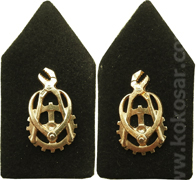
Na znaku su kliješta i par stezaljki položeni na zupčanik sa šesnaest zubaca, od kojih se vidi devet njih. Pozadina za znak je crne boje. Znak je ustanovljen Uredbom br. 57 iz 1947. godine. Prva radionica ove službe je otvorena 01. 02. 1945., koja kasnije dobija ime Radionica za popravak i materijalna inspekcija (Reparatie Inrichtig en Material Inspection). 1946. godine se formira Regimenta tehničkih jedinica (Regiment Technische Troepen). U četvrtom mjesecu 1950. osniva se Tehnička služba (Technische Dienst) kao poseban rod. |
||
 |
 |
|
| CAP BADGE | COLLAR BADGES | |
| Oznaka za beretku | Oznake za revere | |
|
A pair of tongs and callipers are laying on a sixteeen-tooted wheeel, of which nine are visible. Backround is black. Institued by Army-order Nr. 57 from 1947. On February 1, 1945, the first Netherlands REME workshop was opened. Later on, the name was changed to Reparation place and material inspection (Reparatie Inrichtig en material Inspection). In 1946 the formation of „Regiment Technische Troepen“ folowed. In April 1950 the Tecnical Service (Technische Dienst) was created as an independant service branch. |
||
| TRANSPORT CORPS TRANSPORTNE JEDINICE | ||
|
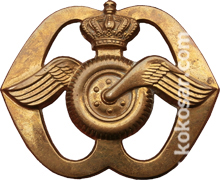
Na znaku se nalazi krilati kotač nadvišen krunom. Boja službe je nassau plavo. Znak je odobren Uredbom br 57 iz 1947 godine. Kako je prilikom mobilizacije 1914-1918. nastala potreba za motornim prevozom, formiran je Dobrovoljački vojni transportni korpus (Vrijwilling Militar Automobiel Korps). 12. 06. 1915. osniva se Korpus motorne službe (Korps Motordienst) i VMAK se nakon nekog vremena raspušta. Sadašnji transportni korpus (Aan-en Afvoertroepen) nastavlja njihove tradicije. Zadatak ove regimente (korpusa) je vojni cestovni promet. |
||
 |
||
|
A winged wheel is surmounted by a Royal crowwn. Badge is approved by Army Order Nr. 57 from 1947. Service colour is Nassau blue. When, in the mobilization of 1914-1918 it was necessary to have motor-transport for the Army, the „Vrijwilling Militar Automobiel Korps“ Voluntary Military Motorcar Corps) was found. On teh 12th of July 1915 the „Korps Motordienst“ (Motor Service Corps) was founded and the V.M.A.K. was abolished later on. The Aan-en Afvoertroepen continue the traditions of the „Korps Motordienst“. The Regiment is carged with the military road-transport. |
||
| QUARTERMASTER CORPS INTENDANTI Intendance | ||
|
Dva klasa pšenice, ukrštena leže na kvadratu napravljenog od lanca sa dvanaest karika, od kojih je deset vidljivo. Karike su na rubovima spojene sa po jednom okruglom karikom. Boja službe je crvena. Znak je odobren Uredbom br. 35 iz 1951. godine. Do tada se ovaj znak koristio za Jedinice keteringa (Verplegingstroepen). Intendanti (Intendance) su u Kopnenj vojsci zaduženi za oprskbu i nabavu. |
||
 |
 |
|
| CAP BADGE | COLAR BADGES | |
| Oznaka za beretku | Oznake za revere | |
|
Two crossed ears of corn, lying on a squair chain of twelve oblong hexagonal links of which ten are visible, on the angular points combined by circular links. Arm of Service colour is crimson. Instituted by Army Order Nr. 35 from 1951. Formerly the same beretbadge was used by qetering troops (Verplegingstroepen). The Quartermaster Corps (Intendance) is charged with the supply and provision of the Army. |
||
| INFANTRY REGIMENT MENNO van COEHOORN REGIMENTA MENNO von COEHORN | ||
|
Znak se sastoji od kravljeg roga, upotrebljavanog kao vojna truba, koji visi sa gornjeg vrha znaka. Ispod znaka visi traka sa natpisom „Menno van Coehoorn“. Značka za beretku, kao i značke za epolete i revere su izrađeni pozlaćenog metala. Odobren je Uredbom br. 337 iz 1953. godine. Regimenta nastavlja tradicije 3. Pješadijske regimente i 1., 2. i 3. mitraljeskog bataljona. Orginalni naziv regimente je bio „Minobacačka regimenta Menno van Coehoorn“. Na zastavi imaju izvješene natpise „Waterloo 1815“ i „Tiendaagse Veldtoch 1831“ u spomen na bitke u kojima su učestvovali. Menno van Coehoorn je general iz 16 vijeka, poznat kao graditelj utvrda. Porodični grb je vojna truba koja se nalazi i na ovom znaku. |
||
 |
||
| Regiment Infanterie Menno van Coehoorn | ||
|
Cow's horn, the bugle, hangs by the chain from the upper edge of the badge. Under the badge is a scroll with words „Menno van Coehoorn“. Beret, sholder and collar badge are maden from gold gilted metal. Badge is instituted by Army-Order Nr. 337 of 1953. The regiment continues the tradition of the 3rd Infantry Regiment and the 1st, 2nd and 3rd Machinegun Battalion. The Regiment is originally called „Mortar Regiment Menno van Coehoorn“. On the regimental colour are hte inscriptions: „Waterloo 1815“ and „Tiendaagse Veldtoch 1831“. Menno van Coehoorn was a 16th century general and fortress architect. The bugle was the coat of arms of Menno van Coehoorn. |
||
| 1st GERMAN/HOLLAND CORPS 1. NJEMAČKO-NIZOZEMSKI KORPUS | ||
|
Zeleni štit obrubljen žutom bojom je podloga znaka ovog korpusa, na kojem se nalazi bijeli mač što ga drže dvije ruke u rukavicama koje na sebi imaju zastave Kraljevine Nizozemske te Federalne Republike Njemačke. Gornja rukavica, nizozemska, je lijevo radi svojeg geografskog položaja, dok je njemačka rukavica ispod jer predstavlja težu (oklopne jedinice) i veću komponentu (2/3 su Njemci). Ispod toga je ispisano, bijelim slovima, COMMUNITATE VALEMUS "Zajednička snaga". Zelena boja podloge je uobičajena boja vojske, dok mač predstavlja i borbenu snagu jedinice i suverenitet dviju nacija. |
||
 |
||
| BERET BADGE | ||
|
Oznaka za beretke |
||
|
This unit insignia is an OD shield, bordered yellow, which bears a sword, with a white blade and a yellow handpart, held by two gloves. The cuff of the left glove bears the colors of the Kingdom of the Netherlands, because the Netherlands lay geographically west of the Federal Republic of Germany. The right (German) glove is below the left (Netherland) glove due to the German element being much "heavier" (armor oriented) and that two-thirds of the soldiers came from the German Army. On the bottom is motto written in white letters: "COMMUNITATE VALEMUS" (United Strength). Color of the shield the represents the military nature of the corps and the sword represents both the combat power of the corps and the sovereingty of the two nations that comprises the corps. |
||
| ABOUT BERET AND COLLAR BADGES O OZNAKAMA ZA KAPE I REVERE | ||
|
Tehnicial, Medical and Administrative beret badge backrounds are obsolete and they are yellow now. Signals beret badge have backround with white edge on left and right side. Intendance collar badge "karmozijn" background is obsolete. |
||
 |
 |
|
| VISOR HAT BADGES OZNAKE ZA ŠAPKE | ||
 |
|
|
| SERGEANT MAJOR | SERGEANT ? | SOLDIERS CAP BADGE |
| (from SGT major up) | ? | (from soldier till corpolar) |
| Od višeg narednika na gore | Od vojnika do kaplara | |
|
B. C. Cats and C. P. Coenders, Netherlands Army Regimental badges, 1968. |
||
ON TOP
 NA VRH
 |
||


