| AUSTRIAN POLICE |
| AUSTRIJSKA POLICIJA |


|
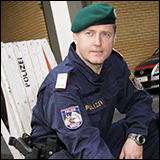
Za održavanje reda i javne sigurnosti u Austriji je zadužena Direkcija za javnu sigurnost, koja je dio Ministarstva unutarnjih poslova Republike Austrije. Ova se Direkcija nalazi u Beču, na adresi Herrengasse 7. Reforma policijskih službi provedena je 01. 06. 2005. Godine i njome su Federalna policija, Žandarmerija i kriminalistička služba objedinjene u jednu organizacionu strukturu. Preko 20000 policijskih službenika raspoređeno je u devet provincijskih komandi sa preko 1000 policijskih stanica. Na rijekama i jezerima za sigurnost i provođenje zakonskih odredbi se brine „Policija na vodi“ sa svojih 70 brodica i ostalih plovila. Koristeći broj 059133 spajate se na centralu najbliže policijske stanice, a broj za hitne slučajeve je 133. |
||
 |
 |
|
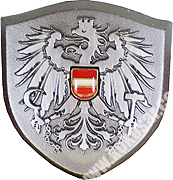
| VISOR HAT CAP BADGE (lower) | VISOR HAT CAP BADGE (upper) | |
| Oznaka za šapku (donja) |
Oznaka za šapku (gornja) |
|
|
Law enforcement in Austria is the responsibility of the Directorate General for Public Security, a subdivision of the Federal Ministry of the Interior located at Herrengasse 7 in Vienna. Law enforcement in Austria underwent restructuring on 1 July 2005. The public security police, the criminal investigation service and the Bundesgendarmerie were consolidated and organized into nine federal provincial commands. Over 20,000 police officers are on duty in the Federal Police at more than 1,000 police stations. On lakes and rivers the federal police has over 70 boats and other craft to act as the Water police. The phone number 059133 connects you to the nearest police station anywhere in Austria. The emergency number is 133. |
||
 |
 |
|
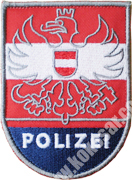
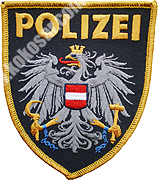
| SLEEVE PATCH | SLEEVE PATCH | |
| Oznaka za rukav | Oznaka za rukav | |
|
Austrijska federalna policija formirana je 2005. godine kao jedinstveno policijsko tijelo. Do tada su se za održavanje reda i sigurnosti brinule razne službe (žandarmerija za većinu zemlje, federalna policija za velike gradove kao što su Beč, Salzburg te kriminalistička služba). 2004. godine Vlada odlučuje sve službe zadužene za osiguranje javnog reda i mira objediniti u jednu organizaciju, koju nazivaju Austrijska savezna policija (Bundespolizei). Policijskim snagama zapovijeda Ministarstvo unutarnjih poslova Republike Austrije. Ono delegira svoju vlast na devet regionalnih policijskih komandi, koje se teritorijalno preklapaju sa devet austrijskih saveznih pokrajina (Beč, Štajerska, Koruška, Salzburg, Donja Austrija, Gornja Austrija, Voralberg, Tirol i Gradišće). Ove komande obavljau svoje djelatnosti kroz policijske stanice u svojoj pokrajini. |
||
 |
 |
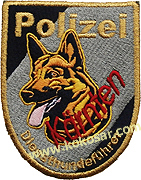 |
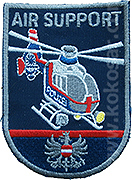
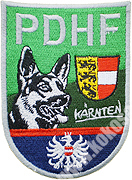
| AIR SUPPORT | K-9 KÄRNTEN (Carinthia) | K-9 KÄRNTEN (Carinthia) |
| Air Support | PDHF (Polizei Diensthundeführer Kärnten) | Polizei Diensthundeführer Kärnten |
| Polocijska zračna podrška | Vodič službenog psa - Koruška | Vodič službenog psa - Koruška |
|
The Austrian Federal Police (Bundespolizei) were formed in July 2005 as one formal unit of police. Before 2005 the police system operated the Gendarmerie for most of the country, and the Polizei in the heavy city and urban areas such as Vienna, Salzburg and Graz. In 2004 it was agreed by the Government of Austria that these two police forces, along with the criminal investigation service, the public security constabulary, and the security authorities, would all form together to become the 'Federal Police of Austria'. The Federal Police is also responsible for border control. |
||
 |
 |
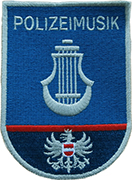 |
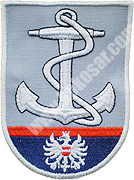
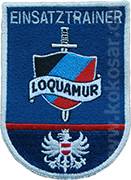
| WATER POLICE | INSTRUCTOR SPECIAL POLICE | POLICE ORCHESTRA |
| Waserpolizei | Einsatztrainer | Polizeimusik |
| Policija na vodi | Instruktor specijalnih jedinica | Polocijski orkestar |
| The current command structure that the Bundespolizei operates is very simple. The Federal Police is commanded by Austrian Federal Ministry of the Interior. The Ministry then delegates to the 9 State Police commands. Depending on the State command, the districts and cities are controlled by either a District Police Command or a City Police Command. These commands then operate through police stations throughout the Province. The 9 State Police Commands are the same as the general States of Austria. Vienna, Styria, Carinthia, Salzburg, Lower Austria, Upper Austria, Voralberg, Tyrol and Burgenland. | ||
 |
 |
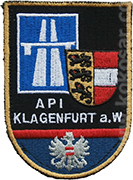 |
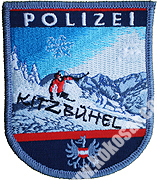
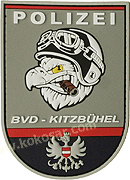
| KITZBÜHEL POLICE | KITZBÜHEL POLICE BVD | HIGHWAY PATROL KLAGENFURT |
| Polizei Kitzbühel | Polizei Kitzbühel BVD | API Klagenfurt am Wörthersee |
| Policija Kitzbühela | Policija Kitzbühela BVD | Prometna, autoputevi, Klagenfurt |
 |
 |
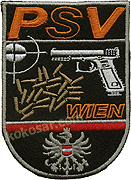 |
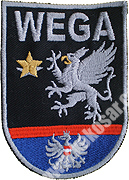
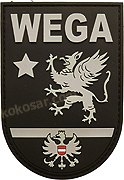
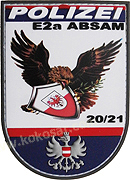
| WIENNA SPECIAL POLICE | WIENNA SPECIAL POLICE | VIENNA POLICE SPORT TEAM |
| Wiener Einsatzgruppe Alarmabteilung | Wiener Einsatzgruppe Alarmabteilung | PSV Wien |
| Specijalna jedinica policije Beč | Specijalna jedinica policije Beč | Bečki policijski sportski tim |
 |
 |
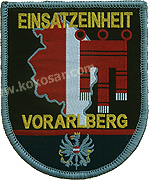 |
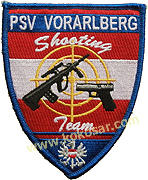
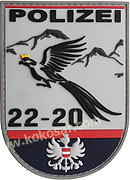
| ? | VORALRBERG POLICE SPORT TEAM | VORALRBERG SWAT |
| PSV Team Voralrberg | Einsatzeinheit Voralrberg | |
| Policijski sportski tim Voralrberga | Specijalna jedinica Voralrberga | |
 |
 |
 |
 |
||
|
PASTORAL CARE PASTORALNA SLUŽBA |
||
|
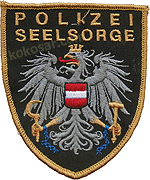
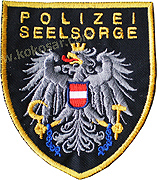
Duhovnu podršku policajcima daje policijsko dušobrižništvo koja postoji već 20 godina. 01. 08. 1996. Pastor mag Martin Müller imenovana je u Beču kao prvi policijski kapelan. „Sporazum o Katoličkom pastoralu u provedbi zakona”, zaključen je u krajem 2002. godine između Biskupske konferencije i Republike Austrije. Sada postoje policijski kapelani u svim regionalnim policijskim upravama (LPD). Dana 26. 09. 2006. godine sklopljen je takav ugovor i za postojeću suradnju sa protestantskom crkvom. |
||
 |
 |
|
|
Spiritual support for police officers is provided by police pastoral care, which has existed for 20 years. On August 1, 1996, Pastor Martin Müller was appointed the first police chaplain in Vienna. "Agreement on Catholic Pastoral Care in Law Enforcement" was concluded at the end of 2002 between the Bishops' Conference and the Republic of Austria. There are now police chaplains in all regional police administrations (LPDs). On September 26, 2006, such an agreement was concluded for the existing cooperation with the Protestant church. |
||
ON TOP
 NA VRH